










 Reading time 10 minutes
Business process automation has evolved from a competitive advantage into an operational necessity.
In an environment where efficiency makes all the difference, organisations can no longer afford to be reliant on manual tasks, siloed systems or fragmented workflows.
The problem isn’t just about time. It’s about inconsistency, duplication of effort and loss of information at every stage of the process.
This is where a new generation of technological solutions comes in. We're not just talking about automating tasks but rather orchestrating complete processes, connecting systems and empowering teams to reach their full potential.
The upshot is clear: greater business productivity, more control and better decisions.
What business process automation is and why it's crucial
Business process automation consists of harnessing technology to run tasks, workflows and operations without constant manual intervention. Yet narrowing it down to that would be an oversimplification.
In practice, it involves redesigning how an organisation operates. Processes no longer depend on specific individuals and information begins to flow automatically between systems. Operational bottlenecks are removed and you gain real-time visibility into everything that's going on.
However, many companies never quite make it all the way. They automate isolated tasks but fail to achieve real transformation. The reason is almost always the same: the key lies not just in automating but in connecting.
Business automation: the leap from tasks to smart processes
Business automation makes headway when it shifts its sights from individual actions to handling entire processes from start to finish.
This is where many organisations run into their biggest hurdle. Their ERP doesn’t talk to their CRM. Internal tools don’t integrate with external platforms. Each system operates as a silo, resulting in partial, fragmented and poorly scalable automation.
Real change happens when an integration layer is built to unify the entire technology ecosystem.
This enables automation of cross-functional processes, centralisation of business logic and scaling up operations without each new tool creating a new connectivity issue. It is not about replacing existing systems but instead getting them to work together seamlessly.
And this is where solutions such as ATLS Global’s HUB, MIA and plugins can help.
ATLS Global's HUB is the nerve centre of business process automation. It's not simply a tool: it's an architecture which allows you to organise, control and run complex processes from a single point.
HUB’s role is to connect systems, define business logic and orchestrate workflows. This completely changes the way a business operates, because instead of having multiple isolated automations which someone has to maintain separately, HUB centralises integrations and allows rules to be managed flexibly and adaptively.
In practice, this means a company can automate the entire order management process across multiple channels, synchronise data between its ERP, CRM and external platforms, or automatically trigger internal events-based processes. This is all done with no manual intervention, with real-time monitoring and also the ability to amend rules whenever business needs dictate.
The outcome is not just efficiency. It's real operational control.
Translation plugins: the key to breaking down technological silos
If HUB is the brain, plugins are the nervous system.
Without genuine connectivity between systems, automation is always incomplete. ATLS's plugins allow all of an organisation's tools to communicate seamlessly with one another, synchronising data in real time and doing away with the need to enter the same information into multiple separate systems.
The direct impact on business productivity is immediate. Duplicate validation tasks, manual data transfers between platforms and errors arising from processes which rely on someone remembering to do something become a thing of the past.
Teams no longer act as intermediaries between systems and can spend that time on tasks which truly call for human judgement.
Automation alone improves efficiency. However, when coupled with intelligence, the impact is magnified.
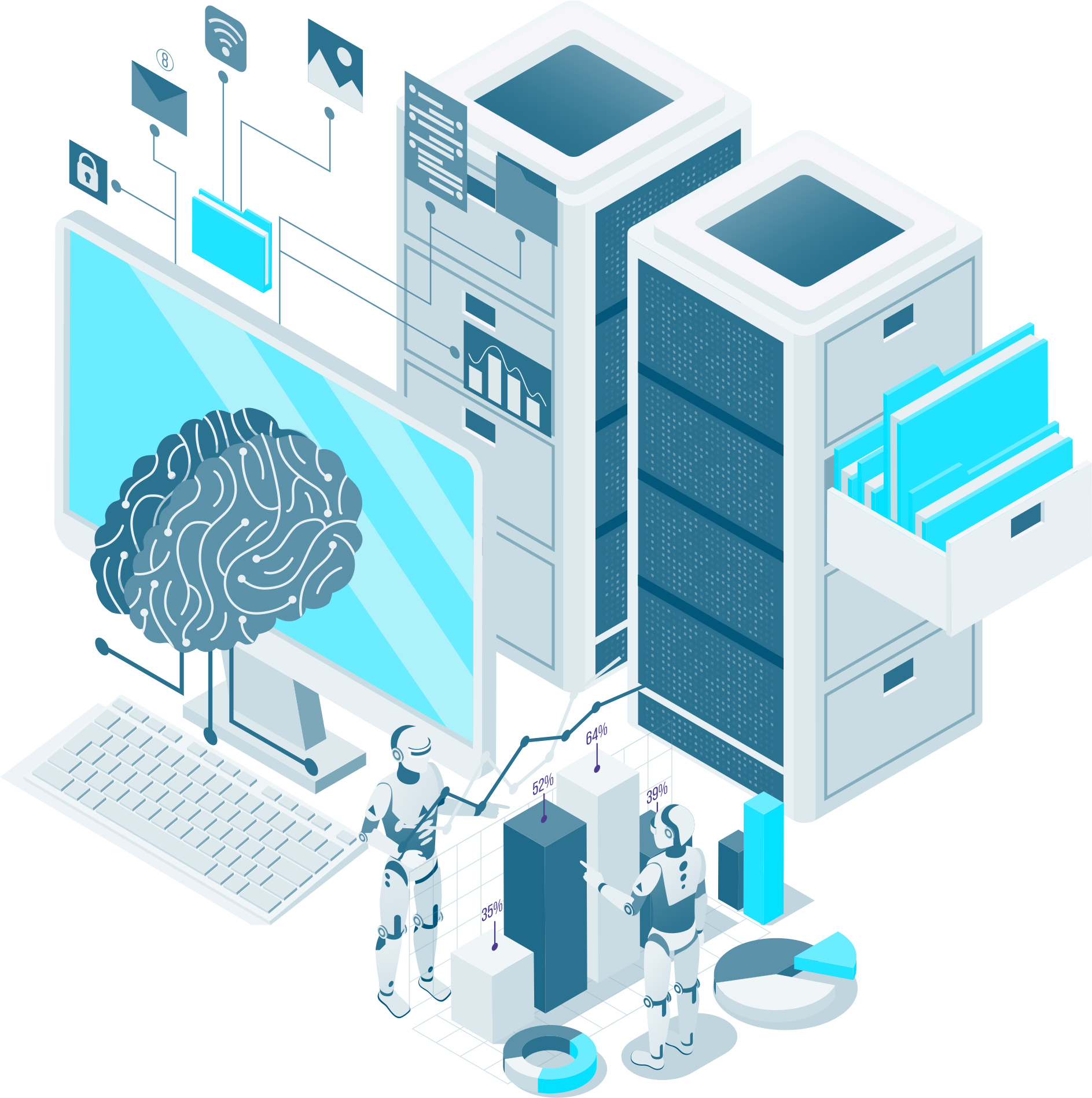
MIA introduces an additional layer: the ability to interpret, decide and execute. This means processes are not only automated but also become smart. MIA can automatically process documents, interpret unstructured data, make decisions based on rules or AI models, and continuously learn from the processes in which it is involved.
In practice, this means automatically classifying documents coming into an organisation, extracting relevant information without anyone having to read them one by one, or triggering the appropriate workflow based on the content identified. The process doesn't wait for a person to kick it off. It happens automatically, accurately and at scale.
This completely transforms business process automation. It's no longer about following predefined instructions. It's about adapting.
Business productivity: the real impact of effective automation
There's a direct link between business process automation and business productivity, yet its full significance isn't always fully grasped. It's not just about doing more in less time. It's about doing better.
At an operational level, well-implemented automation cuts down on errors when performing tasks, shortens response times and improves the quality and consistency of the data the organisation works with.
At the team level, it gets rid of repetitive, low-value work, which not only frees up time but also reduces cognitive load and enhances the employee experience. And at the business level, it enables scaling without a proportional increase in costs, ramps up traceability and regulatory compliance and supports decision-making anchored in real, up-to-date data.
There is one effect which is often overlooked: unlocking talent. Teams no longer spend time on tasks which a machine can do better and instead can address what truly generates value: customer relationships, innovation and strategy. This is where business productivity takes the big leap forward.
Case study: automation in a B2B services company
Picture a professional services company with an active sales team and operations spread across several systems: a CRM for customer management, an ERP for invoicing and a proprietary system for project tracking.
Before automation, the situation is familiar to many organisations. Customer data is updated manually across three different platforms. Quotes are generated by hand and need to be validated via email, with the delays and lost versions which this entails. Project reports are produced by extracting data from numerous sources, making it a time-consuming task which is often delivered late. The team spends between four and six hours a week on purely administrative tasks which add no real value for the customer.
With HUB, plugins and MIA, the scenario changes completely. The plugins synchronise the CRM, ERP and project system in real time: a single piece of updated data in one place is automatically propagated to the rest.
HUB orchestrates the quote approval workflow from automatic generation to delivery, validation and recording without involving any intermediaries.
The outcome is significantly less time spent on administrative tasks, no more errors from manual data entry and quotes delivered in hours rather than days.
Even more importantly: the sales team gets back real time for selling and helping customers. This isn’t an exception. It’s the standard businesses can aim for when they commit to well-integrated business process automation.
The future of business automation
Business automation is evolving towards increasingly smart, connected and autonomous models. The companies which will lead this change will not be the ones with the most tools but rather those that best integrate their technological ecosystems.
This means investing in flexible architectures which do not rely on a single supplier, prioritising connectivity between systems from the design stage and embedding intelligence into processes, not just fixed, rule-based logic.
Organisations which do this won't only be more efficient: they'll also be more adaptable, and in a fast-changing environment, adaptability is the most enduring competitive advantage.
Against this backdrop, solutions such as HUB, plugins and MIA are not just technology. They are a sustainable competitive advantage.
Conclusion: automate to grow, not just to save
Business process automation is not merely a way to cut costs. It's a lever for growth.
It enables enterprises to operate more efficiently, scale seamlessly, adapt more quickly and make better decisions. However, its most important benefit is this: it unlocks the true potential of teams. Technology handles the repetitive work. People add the value.
And that's where the real transformation in business productivity happens.
FAQs about business process automation
What is business process automation?
Business process automation is harnessing technology to run tasks and workflows without manual intervention, improving efficiency, traceability and operational control.
How does business process automation improve productivity?
It cuts down on errors, shortens turnaround times and frees teams from repetitive tasks, allowing them to focus on higher-value strategic activities.
What tools are used in business process automation?
Why is business process automation important?
Because it enables companies to scale up operations, cut costs, improve data quality and react more quickly to the market without upping the workload on their teams.
How long does it take to see results from business automation?
It depends on the scale of the project, but in well-planned implementations using HUB and plugins, the first operational results are evident within weeks, not months.