












 Reading time 7 minutes
In an increasingly interconnected world where commercial, legal and academic transactions constantly cross borders, the need for reliable, fast and secure certified translations is greater than ever.
Businesses, institutions and individuals need official documents which not only comply with traditional legal validity requirements but also provide technological safeguards against the risks of forgery, tampering or loss of authenticity in digital environments.
Mindful of this situation, ATLS Global is taking a groundbreaking step in the translation industry: we've added digital signatures to our certified translation service, an innovative solution with the legal accreditation of a certified translator.
What is a certified translation with a digital signature?
A certified translation is one produced by an official translator accredited by the competent authority in each country (for example, the Ministry of Foreign Affairs in Spain). It is a fully legally valid document which can be submitted in court, to government agencies, universities or notaries certified by Spain's FNMT (National Mint and Stamp Factory).
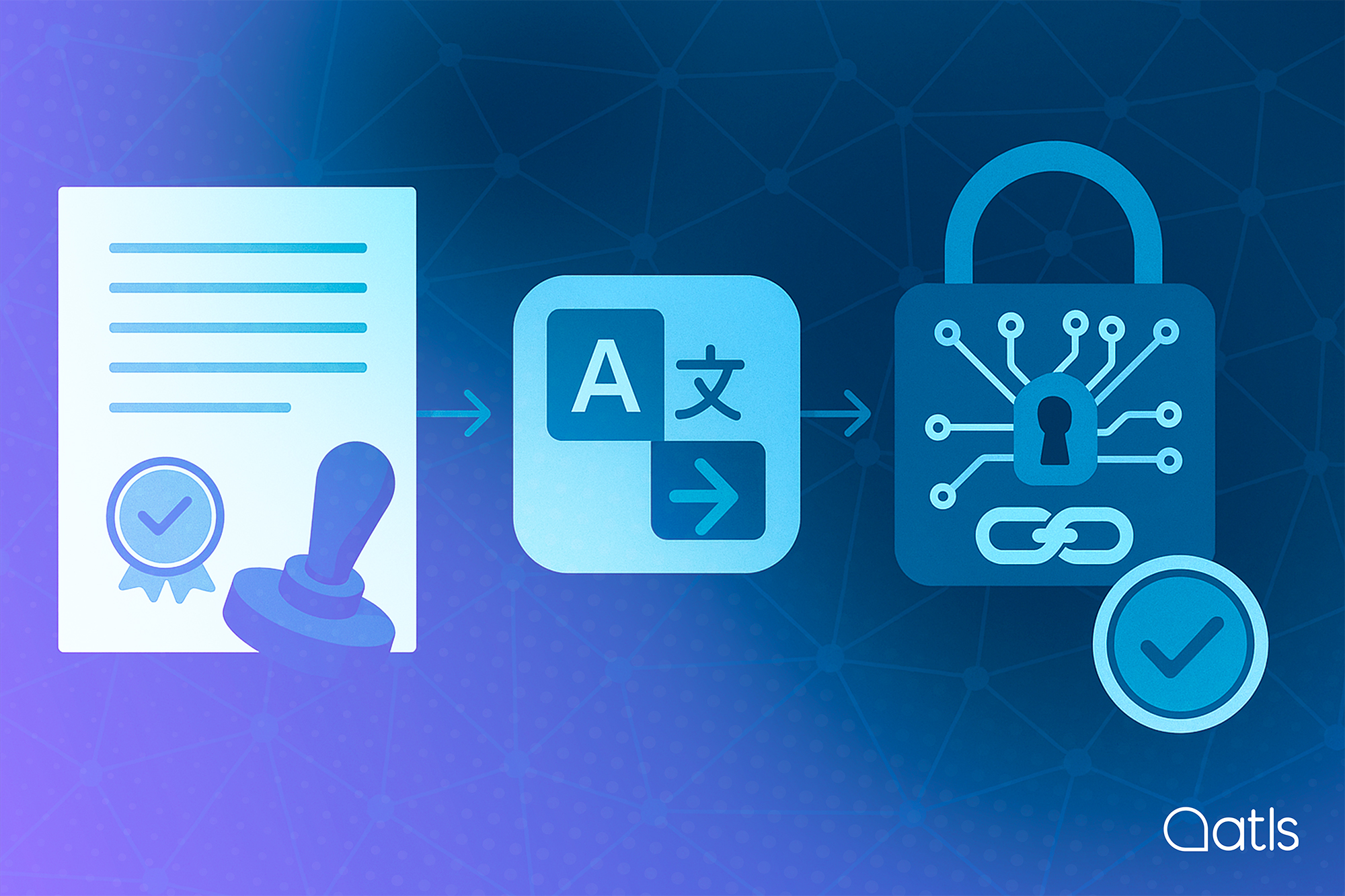
The innovation introduced by ATLS Global is the addition of a technological layer of verification using digital signatures. In practice:
- The certified translator produces and signs the translation as always.
- ATLS applies a certified digital signature to the end document, guaranteeing its authenticity and authorship.
- This signature is a secure electronic seal which certifies the integrity of the file and prevents any unauthorised changes.
- The document is thus protected and verifiable at any time with full legal validity before public and private organisations.
This means that any recipient, whether a judge, a foreign university or a multinational corporation, can verify the authenticity and integrity of the document received with a single click.
The cornerstones of the innovation
- Authenticity: the translation is digitally signed by an accredited certified translator, guaranteeing its authorship and official validity.
- Integrity: the certified digital signature confirms that the document has not been altered since it was issued.
- Traceability: there is verifiable proof of the date, the signatory and the exact version of the document.
- Immediate verification: the recipient can check the validity of the signature and the authenticity of the translation online in seconds with no middlemen.
Why use a digital signature?
It is a secure electronic certification system in which each document is digitally signed and sealed with legal guarantees.
In the context of certified translations, digital signatures make it possible to:
- Eliminate doubts about the authenticity and integrity of the end document.
- Prevent fraud or tampering after issue.
- Build trust in international procedures as it is a recognised and electronically verifiable method.
- Provide a universal validation system regardless of the translator's country of origin or the physical seal.
Real-life use cases of certified translation with digital signatures
1. International academic documentation
A student who submits a translated and digitally-signed university degree certificate to a foreign university no longer needs to go through lengthy verification processes: the institution can check the validity of the digital signature instantly, thus shortening timeframes and reducing the likelihood of incidents.
2. Contracts and notarial instruments
Multinational corporations operating in different countries gain added legal certainty by using certified translations with digital signatures, preventing potential alterations to sensitive documents and simplifying their internal audits.
3. Legal proceedings
In cases where the validity of a document may be challenged, a certified digital signature is technical proof of integrity and authorship, enhancing the chain of custody and legal certainty.
4. Corporate compliance
Legal and compliance departments can include digitally signed translations in their management systems, ensuring traceability, version control and verifiable evidence for third parties.
Advantages over traditional certified translation
- Fast international validation: verification in seconds from anywhere.
- Additional trust in digital environments: demonstrable integrity without physical dependency.
- Reduced verification costs: fewer manual procedures and less operational friction.
- Alignment with digital transformation: compatible with e-justice and e-government processes.
How the process works at ATLS Global
- Commissioning and accreditation: receipt of the original document and assignment to an accredited certified translator based on the required jurisdiction.
- Translation and review: drafting the certified translation and quality review to ensure accuracy and consistency.
- Signature and certification: application of a qualified digital signature by the certified translator with full legal validity.
- Electronic seal: the digital signature is a cryptographic seal of integrity, making sure the document cannot be changed after it has been issued.
- Delivery and verification: the customer receives the translation along with instructions and a verification link to check the authenticity and validity of the signature at any time.
ATLS Global, trailblazers in translation innovation
This breakthrough embodies our approach: we are not just a translation agency but also an internationalisation partner.
We are committed to constant innovation, harnessing artificial intelligence, native plugins and certified digital signatures to deliver secure, efficient solutions for an increasingly digitalised global environment.
Future prospects
Digitalisation of justice, public records and administration is moving forward in many countries. Embedding digital signatures in legal processes will become increasingly common. This innovation puts ATLS Global at the forefront, offering today what will be tomorrow's standard for document security.
FAQs about certified translations with digital signatures
Do digital signatures replace the certified translator's stamp and signature?
No. A digital signature complements the traditional legal process but does not replace it.
The certified translator's stamp and signature are still mandatory to make the document legally valid.
The digital signature adds an additional layer of security and electronic verification, ensuring that the translation cannot be altered after it has been issued.
What happens if someone tries to change the document after it's been signed?
Any changes to the file automatically invalidate the digital signature.
The system will check it and see that the document does not match the signed original, showing that it has been altered and therefore is not legally valid.
The digital signature is thus technical proof of integrity.
Is a certified translation with a digital signature legally valid?
Yes. Certified translations with digital signatures remain fully legally valid as they are still done and signed by accredited certified translators.
The digital signature simply enhances the authenticity, integrity and traceability of the document, ensuring greater confidence in national and international procedures.
Where are certified translations with digital signatures accepted?
Certified translations with digital signatures can be submitted to courts, notaries, registries, universities and public or private organisations.
Their electronic validation system also enables international verification, bringing transparency and trust even in jurisdictions where the physical seal of the country of origin is not recognised.