












 Reading time 13 minutes
Using artificial intelligence to translate business documents no longer seems like a technological decision. It seems like a common-sense decision. It's fast, convenient, and allows a legal, commercial, medical, financial, or human resources team to move forward without waiting days for a translation.
The scene is familiar: Someone receives a contract in English, copies the text, pastes it into an AI tool, and in seconds gets a seemingly flawless Spanish version. The translation seems correct. The process seems efficient. The problem seems to be solved.
But the real trouble may have just begun.
When we talk about confidentiality in the companyTranslating sensitive documents with AI cannot be analyzed solely from the perspective of linguistic quality. We need to ask ourselves where the data travels, who processes it, how long it is kept, whether it can be used to train models, what subprocessors are involved, what contractual guarantees exist, and who is responsible if something goes wrong.
Artificial intelligence can be a very powerful tool. But when a company works with contracts, medical reports, payrolls, court records, financial documentation, confidentiality agreements, or personal data of clients and employees, translation ceases to be a simple operational task. It becomes a decision of safety, compliance, and responsibility.
That's where the difference between an automated tool and a professional translator becomes essential.
Confidentiality within the company: which documents pose a real risk
The first mistake many organizations make is thinking that risk only appears when a document is marked as "confidential". A sales contract, a medical report, a payroll, or a due diligence report all seem clearly sensitive. However, the business reality is more complex.
A document can compromise the confidentiality in the company even if it doesn't reveal an obvious trade secret. It may contain personal data, customer names, prices, commercial terms, employment information, legal clauses, financial data, health information, internal strategies or details of a future transaction.
This means that a customer complaint email, an employee file, a business proposal, a confidentiality agreement, an internal presentation, or a technical report may also require caution.
The problem arises when these texts are entered into an external tool without the company knowing exactly what happens next. From the perspective of the GDPR, if the document contains personal data, there may be data processing. From a corporate security perspective, if the document contains strategic information, there may be a loss of control over confidential information.
The question, therefore, is not just whether AI translates well. The question is whether the company can allow that document to be entered into that tool, under what conditions, and with what guarantees.
Not only are contracts confidential: how to identify the real risk of a document
Not all company documents have the same level of risk. A public product description does not require the same level of control as an employment contract. A press release does not present the same scenario as a medical file.
A document can be considered sensitive for several reasons:
- Personal details: names, surnames, emails, telephone numbers, addresses, identification documents, employment data or financial information.
- Special categories of data: information on health, union affiliation, biometric data, beliefs, ethnic origin or sexual orientation.
- Confidential business information: prices, trade agreements, strategies, financial forecasts, intellectual property, internal processes or product documentation.
- High level of criticality: documents where a translation error would have legal, medical, economic, or reputational consequences.
In practice, many documents combine several layers of risk. A contract may include personal data, confidentiality clauses, and legal implications. A due diligence process can gather financial, corporate, labor, and commercial information.
Therefore, translating sensitive documents with AI without a clear framework can be problematic. The tool can resolve the linguistic aspect, but not the contractual, legal, and liability aspects.
GDPR and AI-powered translation: what your company may be failing to comply with without knowing it
Entering a document containing personal data into an external tool can be equivalent to communicating information to a third-party technology provider. That raises important questions: What is the purpose of the processing, who accesses the data, where is it processed, how long is it kept, is it transferred outside the European Economic Area, are there any sub-processors, and can the provider use the content to improve its models?
A free or general-purpose tool may seem harmless because it does not require configuration, a contract, or validations. But precisely that lack of friction can be part of the risk. If there is no DPA, if the retention policy is unknown, if there are no guarantees of non-training, or if it is unknown where the information is processed, the company may not have sufficient control over the processing.
In sensitive documents, this point is especially delicate. Employment contracts, medical records, court documents, financial reports or communications with clients may contain personal data, confidential information or even special categories of data. If those documents are uploaded to an AI tool without adequate safeguards, the problem is not just linguistic. It's legal, reputational, and safe.
Compliance is not based on generic trust in a technology brand. It is based on contracts, documentation, technical measures, privacy policies, data processing agreements, subprocessor control, and traceability.
Therefore, when a company needs to translate sensitive documents, the question should not only be "which tool translates best?". The question should be, "What process best protects information and allows us to demonstrate compliance?"
What no free tool can guarantee you when translating something confidential
The confidentiality in the company Protection is not achieved with good intentions alone. It is protected with clear processes, contracts, and responsibilities.
An NDA allows for the establishment of specific obligations regarding the use, access, custody, and non-disclosure of information. In professional translation, this type of guarantee can be part of the working framework between client, agency and specialized translators. A free AI tool does not offer that same level of contractual protection.
Traceability is also key. In sensitive documents, the company may need to know who has intervened, what version has been worked on, under what conditions, and what controls have been applied. A professional translation can be integrated into a documented workflow. An improvised translation in an open tool hardly offers that same control.
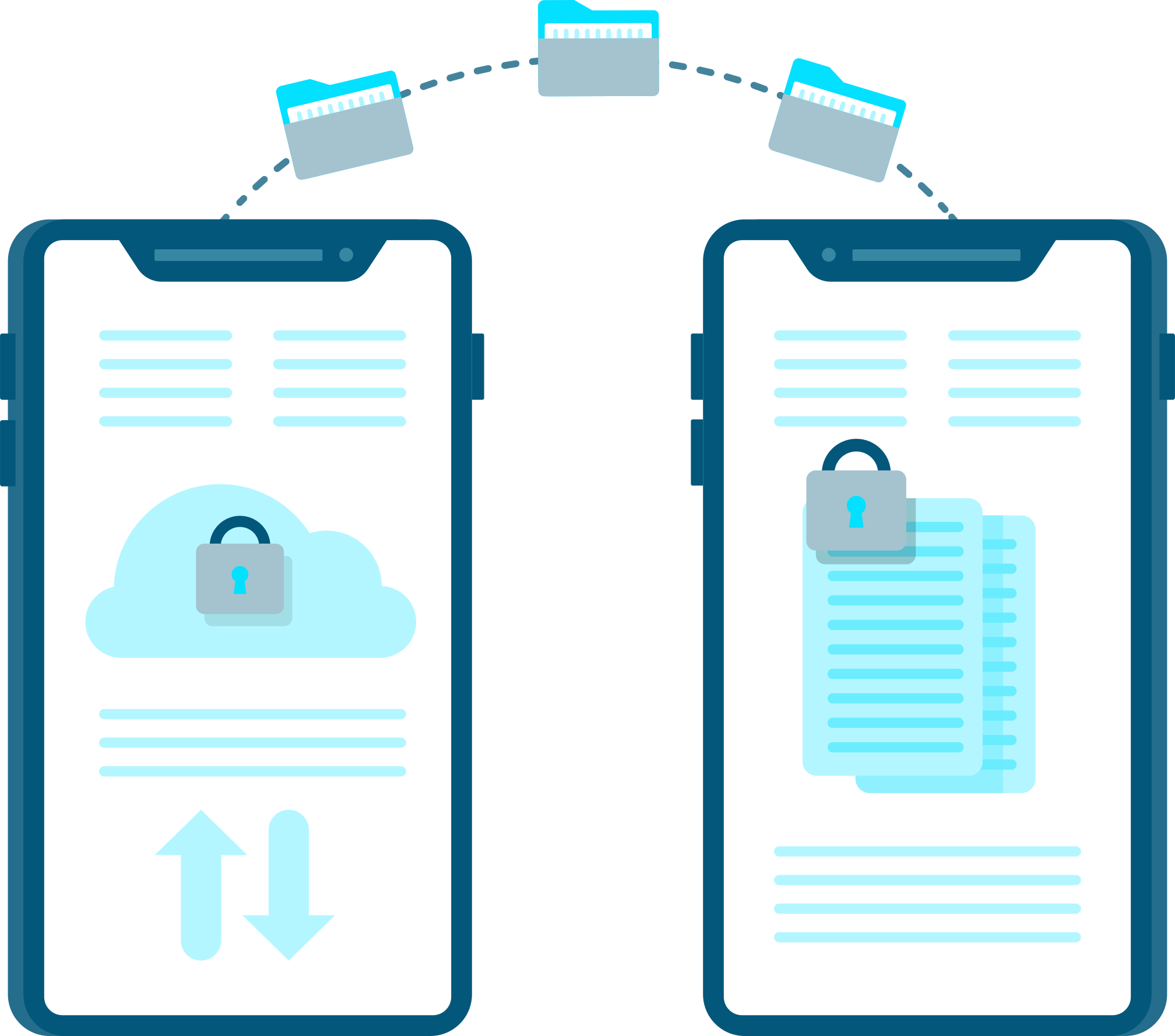
And there is responsibility. If a tool generates an incorrect translation, or if an employee enters confidential information into an unapproved environment, who is responsible? The technology provider? The user? The company? Is there a contract that regulates that use?
A professional translator does more than just deliver words in another language. It is part of a chain of responsibility. And in sensitive documents, that chain matters.
AI and professional translation can coexist, but they are not interchangeable.
The comparison is usually framed incorrectly. It's not speed versus quality, nor cost versus human review. The real difference, when we talk about sensitive documents, lies in three levels of protection that AI alone cannot offer.
On a contractual level: NDAs, confidentiality agreements, and clear commitments on non-disclosure. On an operational level: Secure channels, access control, version management, and controlled file deletion. On the linguistic level: specialized criteria, detection of ambiguities, legal or medical terminology, and consistency with the entire document, not just the isolated phrase.
AI can be part of a professional workflow. It can speed up drafts, support terminological analysis, or reduce time spent on low-risk content. But it does not replace professional responsibility or the contractual framework when personal data or critical information is at stake.
In other words, AI can be a tool within the process. It shouldn't be the whole process.
These documents should not be processed by uncontrolled AI (and they may already be).
There are documents that should not be managed solely with an open AI tool or without clear business guarantees: contracts with clients, suppliers, employees or strategic partners; payrolls; medical records; expert reports; court documents; financial documentation; due diligence; investor communications; patents; unpublished technical documents; customized business proposals; confidentiality agreements; corporate minutes; and any file containing personal data or strategic information.
In these cases, the risk is not only that the AI will translate incorrectly. It also lies in the fact that the company cannot demonstrate how the information has been handled, who has accessed it, or where it has been processed.
It is also advisable to be especially cautious when the document contains information from third parties: data of clients, patients, employees, candidates, suppliers or partners. The company may have contractual or legal obligations regarding that information, even if the document is translated for internal use.
What many companies fail to calculate is how much that shortcut might cost.
Savings that could end up costing you dearly: hidden costs of a bad documentary decision
AI can reduce time and costs in many scenarios. But in sensitive documents, the apparent savings can be costly if there is a leak, a breach of contract, a security breach, or a faulty translation.
The cost of mistranslating a contractual clause can be much higher than the cost of a professional translation. The cost of exposing personal data can far outweigh the savings from using a free tool. The reputational cost of being unable to explain where a confidential document has gone can affect the trust of customers, employees, and partners.
Efficiency is important, but it cannot be the only criterion. In sensitive translation, value is not just about delivering quickly. It's about delivering with guarantees: confidentiality, review, specialization, document security, and responsibility.
A mature company shouldn't just ask how long it takes an AI to translate a document. You should ask yourself how much risk you are taking by introducing that document into a tool that is not part of a controlled process.
The more AI you use, the more internal politics you need: That's how it should work
The adoption of artificial intelligence tools has made it easier to make silent mistakes. Previously, many organizations controlled their translation providers, their contracts, and their document delivery channels. Now, any employee with access to an AI tool can process sensitive information in a matter of seconds.
That change requires more internal governance, not less.
A company should define which AI tools are allowed, for what uses, with what type of documents, and under what conditions. It should also define what content is excluded from open or unapproved tools, and train its teams accordingly: Many breaches occur not due to bad faith, but due to a lack of knowledge.
The privacy policy needs to be updated to reflect the actual use of AI. It is not enough to have confidentiality clauses in employment contracts if there is no clear rule on how to handle sensitive documents in digital tools.
Document security must be part of the operational culture.
Practical guide: How to manage sensitive multilingual documents with guarantees
A company that works with sensitive documentation in multiple languages should have a clear process:
- Classify the documents according to their level of risk. Not all texts require the same treatment. Public content can have an agile flow. A contract, a medical report, or due diligence must be handled with enhanced controls.
- Identify whether the document contains personal data or confidential information. This distinction activates different obligations: data protection, contractual confidentiality, information security and reputation management.
- Decide which provider or professional can intervene. For sensitive documents, it is advisable to work with specialized translators who are subject to confidentiality agreements.
- Use secure transfer and storage channels. Security depends not only on who translates, but also on how files are sent, received, reviewed, and stored.
- Maintain traceability of the process. In certain sectors, knowing who has been involved, what version has been translated and under what conditions can be as important as the final translation.
- Combine technology and human review in a proportionate manner. AI can bring efficiency, but the professional translator brings judgment, responsibility, and control.
This approach allows you to leverage technology without turning it into a compliance blind spot.
How we at ATLS Global work with documents that cannot be exposed
At ATLS Global we work with companies that cannot afford mistakes in the management of their sensitive documentation. Legal, medical, financial, labor, technical: Each type of document has a different level of risk and requires a process adapted to that risk.
Our approach combines technology and professional review with a clear security framework: specialized translators, confidentiality agreements, secure shipping channels and process traceability. We don't just translate text. We manage responsibility for the document.
When speed matters but the confidentiality in the company It's non-negotiable; the difference isn't in the tool you use. It's in the process behind it.
Do you need to translate sensitive documents with guarantees? Tell us about your case and we'll explain how we can help you.
Confidentiality is not a function of a tool. It's your company's responsibility.
Artificial intelligence has reduced time, democratized capabilities, and opened up new possibilities for efficiency. But it has also made it easier to make silent mistakes.
When we talk about company confidentialityThe real challenge is not technological. It's about governance, responsibility, and security. A company needs to know what data it handles, what tools it allows, what guarantees it requires, and who is responsible for the result.
Translating sensitive documents with AI may seem like a quick fix. But without data control, NDAs, traceability, professional review, and GDPR guarantees, speed can become a risk.
AI can be an advantage. But it will only be sustainable if it is integrated with sound judgment, appropriate contracts, and a clear culture of information protection.
The future does not belong to the companies that use the most AI. It belongs to those who know how to best protect what they translate.