
















 Reading time 11 minutes
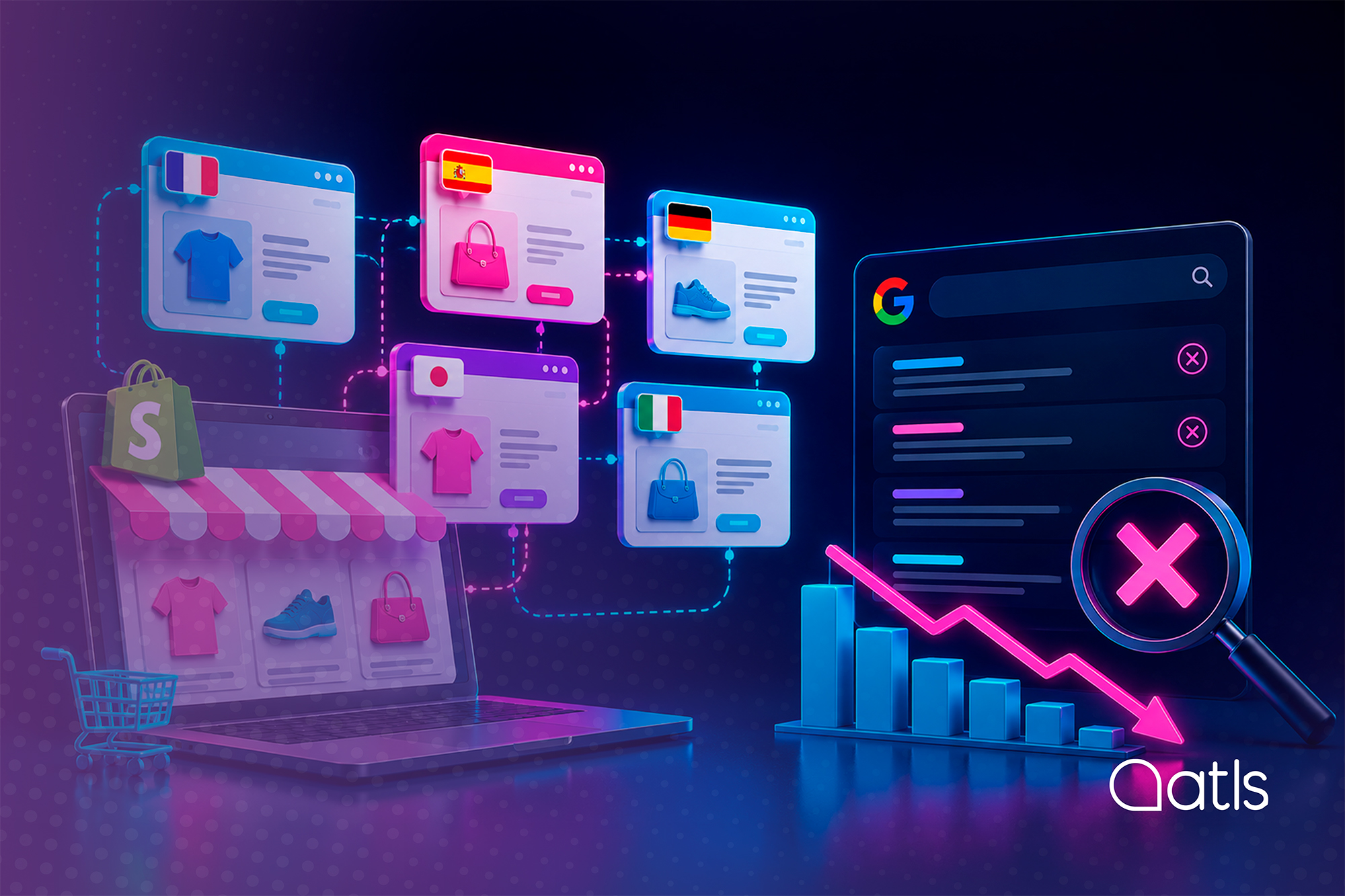
That's the big mistake in many international Shopify SEO strategies. The store is translated, languages are activated, markets are published, and the assumption is that Google will automatically understand which version to show in each country.
60% of consumers prefer to browse in their language, and a significant portion avoid making a purchase when the content is not well localised. A store can be technically prepared to sell in several countries and still remain almost invisible on search engines outside its main market.

That's why international SEO for Shopify requires much more than translating content. It requires an understanding of how Google interprets a multilingual architecture, how to properly segment markets, and how to adapt each version to rank and convert in different countries.
SEO international for Shopify: the mistake of translating without a strategy
One of the most frequent mistakes in international e-commerce is thinking that an automatic translation or a superficial adaptation of the catalogue solves the problem of SEO. In practice, that only creates a layer of seemingly localised content, but it's not enough to rank strongly in each market.
A Shopify store can have versions in English, Spanish, French, German, or Italian and still send confusing signals to Google. This happens when you keep meta titles copied from the original version, URLs poorly adapted to the language, overly literal content, incomplete hreflang tags, or canonicals that prioritise a main version even though there are well-differentiated local variants.
The most frequent problems that usually appear are:
- Meta titles and meta descriptions copied from the original version.
- URLs or slugs poorly adapted to the language of the market.
- Literal translations that do not match the local search terms.
- Incomplete or inconsistent hreflang tags.
- Canonicals that continue to prioritise the primary market version.
This means that the problem is not usually in the intention to internationalise, but in the execution. Many companies translate product descriptions, menus, and collections, but they don't check if each market searches in the same way, uses the same terminology, or expects the same level of information before buying. And that's where the loss of visibility begins.
Hreflang and canonicals, two decisive signals
Hreflang tags remain an essential part of international SEO. According to Google Search Central, they serve as a way to indicate localised versions of the same page and help the search engine to show the most appropriate one according to language or region. But it's important to understand their function. They do not detect the language on their own, but rather reinforce the interpretation of a well-constructed multilingual architecture.
In Shopify, some of this logic can be set up automatically when international domains or market subfolders are used correctly. Even so, that doesn't mean the job is done. If there are pages without reciprocity between versions, if variants are missing, if a URL does not match the market logic, or if canonicals point to a page that should not consolidate authority, the system begins to generate friction.
The most serious mistakes are usually these:
- Hreflang without self-referencing.
- Language versions that are not linked to each other.
- Misconfigured language or country codes.
- Canonicals pointing to the original version instead of the localised version.

In practice, this means that simply “having hreflang” is not enough. You need to check if it is properly implemented, if each version references itself and its equivalents, and if the entire architecture follows a coherent international logic. When that doesn't happen, Google may ignore those signals or interpret them with a lower degree of confidence.
It is also worth remembering an important detail: A poor technical configuration not only affects ranking, it affects the user experience. If a customer in France lands on a Spanish version, or if a German user sees a page in their language but with snippets, slugs, or legal notices in another language, the perception of quality immediately drops. And in international e-commerce, trust matters as much as traffic.
The silent problem of legal pages and non-localised URLs
One of the most frustrating aspects surrounding many multilingual Shopify stores is found on pages such as the privacy, refunds, and shipping policies, or the terms of service. Although the content may be translated, not all the elements around those pages are always well localised, especially when inflexible structures or partial configurations are inherited.
It may seem like a minor detail, but it's far from it. Legal content is also part of the shopping experience and the user's trust framework. When a store is fully adapted to a market and suddenly directs the user to a URL or legal page with a different linguistic logic, the sense of consistency is broken.
This problem affects three areas in particular:
- SEO, because it can generate ambiguous signals about the actual language of the page.
- Trust, because the user perceives a lack of adaptation.
- Conversion, because any doubt about policies, shipping or returns can hinder the purchase.
From a conversion point of view, these kinds of inconsistencies project a less polished image. The key is to understand that localisation doesn't start and end with the catalogue. It also includes navigation, footer, legal notices, metadata, and support structures.
Machine translation: useful, but not sufficient
Machine translation has improved a great deal and today can be a great operational accelerator for stores with large catalogues. Shopify also makes this process easier with tools like Translate & Adapt. The problem arises when that translation is taken as the final version and not as a starting point.
A store can have texts that are correctly translated from a grammatical point of view and still sound foreign to the target market. This happens a lot with terminology around a product, commercial claims, expressions of trust, delivery messages, calls to action, and support content. The translation is understandable, sure, but it is not always persuasive, it doesn't always rank well, and it doesn't always sell.
The difference between translating and localising is just that. Localisation is about adapting the language to the actual way a market searches, compares, and decides. It involves reviewing whether it's appropriate to keep a term in English, whether a commercial promise sounds natural, whether a category responds to the correct intention, and whether the brand tone fits culturally with the local user.

Therefore, key pages need a specific review:
- Main categories.
- Strategic products.
- Landing pages by market.
- Meta titles and meta descriptions.
- CTAs and messages of trust.
The upshot is clear: without editorial quality control and SEO, a multilingual store may end up publishing pages that are technically correct but commercially weak.
Multilingual SEO in Shopify starts before translation
An effective strategy doesn't start with the language panel. It begins with research. Before adapting categories, products, or landing pages, you need to know how each market searches, what terminological variations it uses, what doubts it expresses, and what type of content it expects to find before converting.
That completely changes the approach. It's no longer about duplicating pages in multiple languages, but about building organic assets designed for each search context. In some markets, locating index cards and collections will be all you need. In others, you'll need to reinforce the content with guides, comparisons, frequently asked questions, or specific pages to address objections.
This point is especially important in Shopify because many stores rely too heavily on the catalogue as their SEO engine. But when they target several countries, the catalogue alone does not always cover the entire search intent. They need content that connects with the discovery, evaluation, and trust phase.
What does a Shopify store need to rank outside its core market?
For a multilingual store to truly compete on Google, it needs to align three layers simultaneously. The first is the technical layer, which includes URL structure, indexing, internal linking, hreflang tags, canonical tags, and the relationship between domains and markets. The second is the linguistic layer, where it is decided whether the content sounds natural, useful and adapted to the local user. The third is the strategic layer, which connects each page to a real search intent.
When one of those layers fails, international performance suffers. When two or three fail, the store may seem ready, but it fails to grow on Google.
An audit should check, above all:
- If Google understands the international architecture.
- If each language has truly localised content.
- If the key pages respond to real searches.
- If the priority markets have their own landing pages, categories, and content.
Therefore, a serious audit of an international Shopify store should not be limited to checking whether there are published translations. It should ask more important questions: If Google understands the architecture, if the user trusts the experience, and if the content responds to how people search in each market.
Multilingual Shopify is not synonymous with international visibility

International SEO for Shopify does not depend solely on activating multiple languages or markets. It depends on how the architecture is built, how the content is localised, and how Google interprets each version of the store.
In other words, a multilingual store can be active, translated, and published, and still remain invisible in the searches that really matter. The difference between an adequate international presence and a competitive international presence lies in the precision with which all of the above is executed.
When that precision exists, the change is noticeable. Google better understands what to show, the user gets a more consistent experience, and the brand begins to grow with a much more solid organic base. It's not just a technical issue, it's a business matter.
Frequently asked questions about international Shopify SEO on Google
What is international SEO on Shopify?
International SEO on Shopify is the set of technical, strategic and content actions that allow a multilingual store to rank on Google in different countries and languages. It's not just about translating the store; the structure, URLs, hreflang tags, and content also needs to be adapted to each market.
Why doesn't translating a store guarantee international SEO on Shopify?
Because a translation alone does not answer the question of how each user searches in their country or how Google interprets each version of the website. Without a real location, clear architecture, and well-implemented technical signage, the store may be translated and still fail to rank.
How do hreflang tags influence international SEO on Shopify?
Hreflang tags help Google understand which version of a page corresponds to each language or region. They are the key to prevent the search engine from showing the user an incorrect version, although they must be properly configured and aligned with the overall structure of the store.
What are the most frequent mistakes in an international SEO strategy for Shopify?
The most common mistakes are translating without local keyword research, keeping meta titles and slugs from the original version, using incorrect canonicals, leaving hreflang incomplete, and publishing content that sounds forced or unnatural to the market.
Does machine translation work as a strategy for international SEO on Shopify?
Yes, it can serve as a base to work from and as operational support, especially in large catalogues, but it shouldn't be the final version without prior revision, because an automatic translation doesn't always reflect the search intent, the commercial tone, or the natural language of each market.
What should an audit of an international SEO strategy for Shopify review?
You should review the store's international architecture, the relationship between domains or subfolders, the implementation of hreflang and canonicals, the localisation of the content, and whether the key pages respond to real searches in each country.
Which pages are a priority in a strategy for international SEO on Shopify?
The most important ones are usually the main categories, strategic products, landing pages by market, legal pages, and metadata. These are the areas where a poor localisation can most affect ranking, trust, and conversion.